
Research @ Gladia, ISTA
Tommaso Mencattini
Hey! I’m Tommaso, currently doing a Master’s in Data Science at EPFL.
Between lectures and problem sets, I spend my time at ISTA and GLADIA working on LLMs, mainly figuring out how to make them more interpretable and safer.
My academic path is a bit unconventional: I hold a BSc in AI and Mathematics and a BA in Philosophy. That means I probably know more math than most philosophers, more computer science than most mathematicians, and more philosophy than most computer scientists. Not entirely sure if that’s a strength or just confusing, but it definitely keeps things interesting.
news
| Aug 21, 2026 | Two papers accepted at EMNLP 2026: Subliminal Clocks (Main) and Steering Vectors are an Adversarial Attack Surface (Findings)! |
|---|---|
| Aug 10, 2026 | Our paper Multi-objective Evolutionary Merging Enables Efficient Reasoning Models has been accepted at COLM 2026! |
| Aug 01, 2026 | Proposer of a research team at Rome AI Safety (RAIS), funded by Coefficient Giving with $80k to develop disentangled, composable steering vectors for fine-grained behavioral control of LLMs. |
| Jan 28, 2026 | Our paper Exploratory Causal Inference in SAEnce received an oral presentation at ICLR 2026! |
| Jan 26, 2026 | Our paper Language Models Are Injective and Hence Invertible has been accepted at ICLR 2026. |
talks
| Jan, 2026 Invited Talk | Presented Language Models Are Injective and Hence Invertible at Apple @ Aachen (S. Peitz Group) |
|---|---|
| Dec, 2025 Invited Talk | Gave a talk on Language Models Are Injective and Hence Invertible at Baker Hughes |
| Nov, 2025 Invited Talk | Discussed Language Models Are Injective and Hence Invertible at Area Science Park (University of Trieste) |
libraries
- A flexible library for merging large language models (LLMs) via evolutionary optimization. It frames model merging as a black-box optimization problem and uses techniques like genetic algorithms and smart performance estimators to search for optimal weight combinations.

selected publications
-
 Under Sub., 2026
Abstract
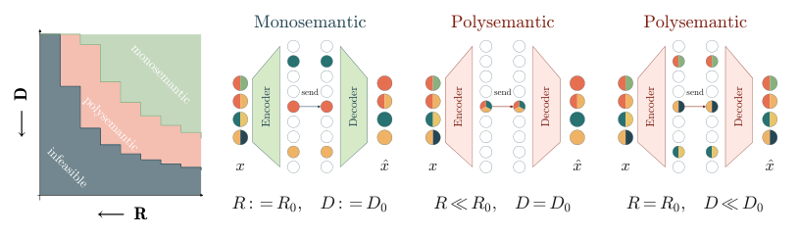
Sparse Autoencoders (SAEs) that can accurately reconstruct their input (minimizing distortion) by making efficient use of few features (minimizing the rate) often fail to learn monosemantic representations (highly interpretable), limiting their usefulness for mechanistic interpretability. In this paper, we characterise this tension in learning faithful, efficient, and interpretable explanations, introducing the Rate-Distortion-Polysemanticity tradeoff in SAEs. Under toy-modeling assumptions, we theoretically and empirically show that restricting the SAE to be monosemantic necessarily comes with an increase in rate and distortion. Assuming a generative model behind the input observations, we further demonstrate that the degree of polysemanticity of optimal SAEs is determined by the training data distribution, especially by the probability of features to co-occur. Finally, we extend the analysis to real-world settings by deriving necessary conditions that a polysemanticity measure should satisfy when the data-generating process is unknown, and we benchmark existing proxy metrics on SAEs trained on Large Language Models. Taken together, our findings show that polysemanticity is a data problem that should be accounted for when addressing it at the architectural and optimization level.
-
 In ICLR, 2026
Abstract
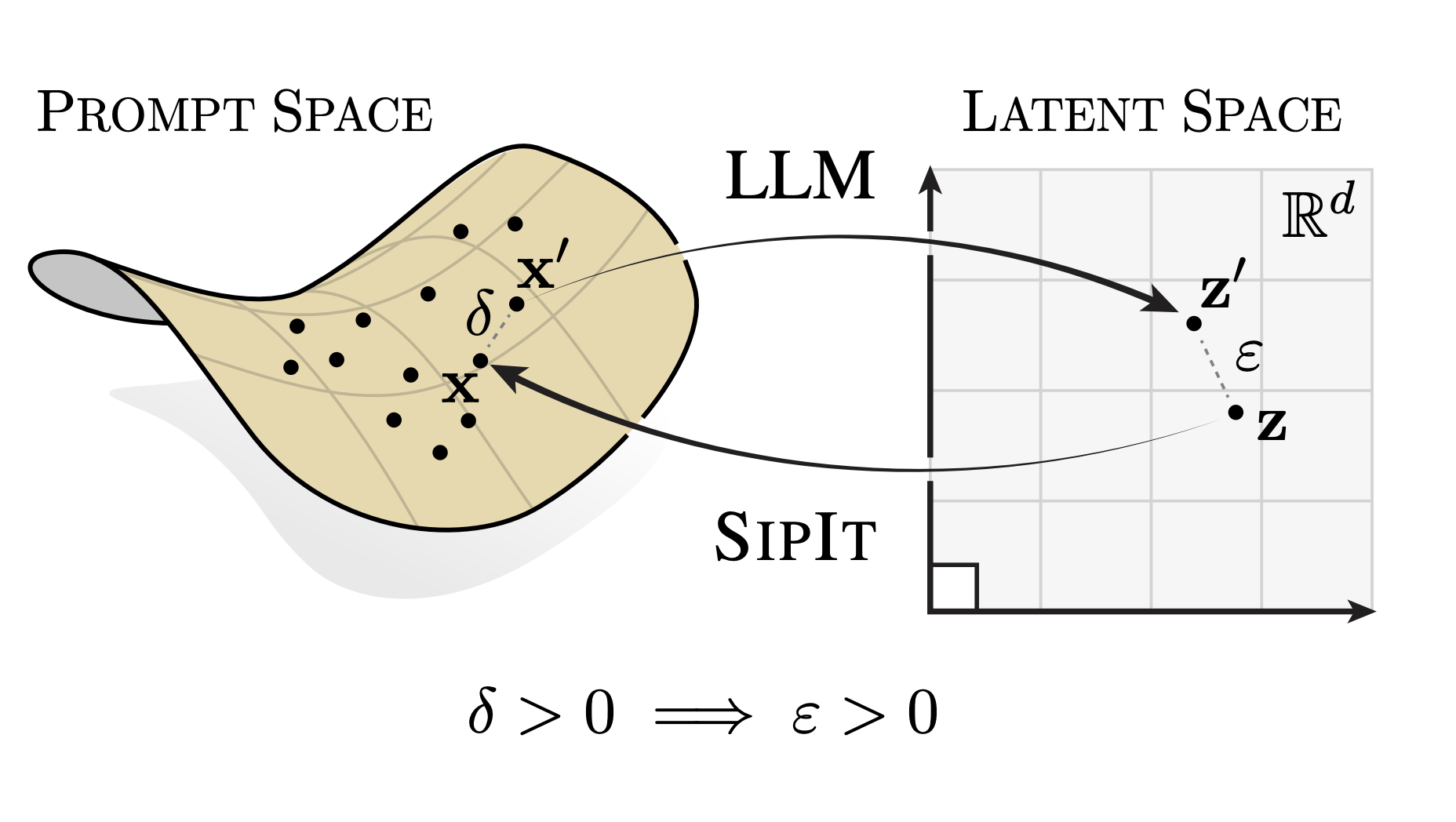
Transformer components such as non-linear activations and normalization are inherently non-injective, suggesting that different inputs could map to the same output and prevent exact recovery of the input from a model’s representations. In this paper, we challenge this view. First, we prove mathematically that transformer language models mapping discrete input sequences to their corresponding sequence of continuous representations are injective and therefore lossless, a property established at initialization and preserved during training. Second, we confirm this result empirically through billions of collision tests on six state-of-the-art language models, and observe no collisions. Third, we operationalize injectivity: we introduce SipIt, the first algorithm that provably and efficiently reconstructs the exact input text from hidden activations, establishing linear-time guarantees and demonstrating exact invertibility in practice. Overall, our work establishes injectivity as a fundamental and exploitable property of language models, with direct implications for transparency, interpretability, and safe deployment.
-
 In ICLR (Oral), 2026 Oral
Abstract
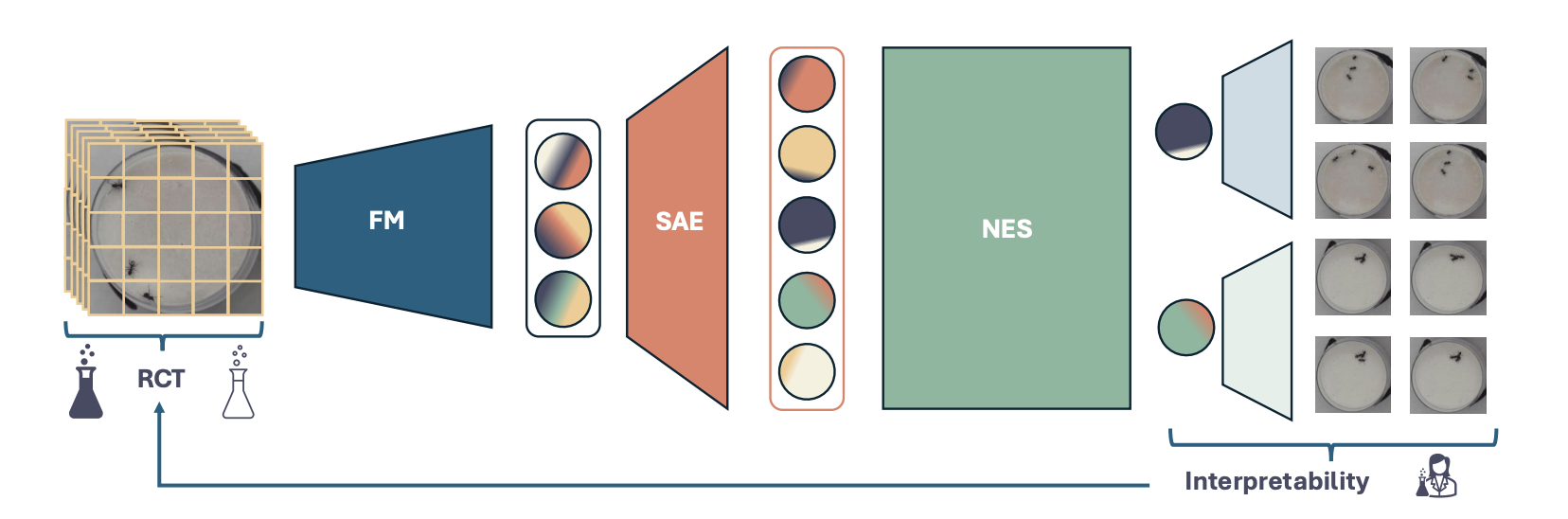
Randomized Controlled Trials are one of the pillars of science; nevertheless, they rely on hand-crafted hypotheses and expensive analysis. Such constraints prevent causal effect estimation at scale, potentially anchoring on popular yet incomplete hypotheses. We propose to discover the unknown effects of a treatment directly from data. For this, we turn unstructured data from a trial into meaningful representations via pretrained foundation models and interpret them via a sparse autoencoder. However, discovering significant causal effects at the neural level is not trivial due to multiple-testing issues and effects entanglement. To address these challenges, we introduce Neural Effect Search, a novel recursive procedure solving both issues by progressive stratification. After assessing the robustness of our algorithm on semi-synthetic experiments, we showcase, in the context of experimental ecology, the first successful unsupervised causal effect identification on a real-world scientific trial.
-
 In ICML, 2025
Abstract
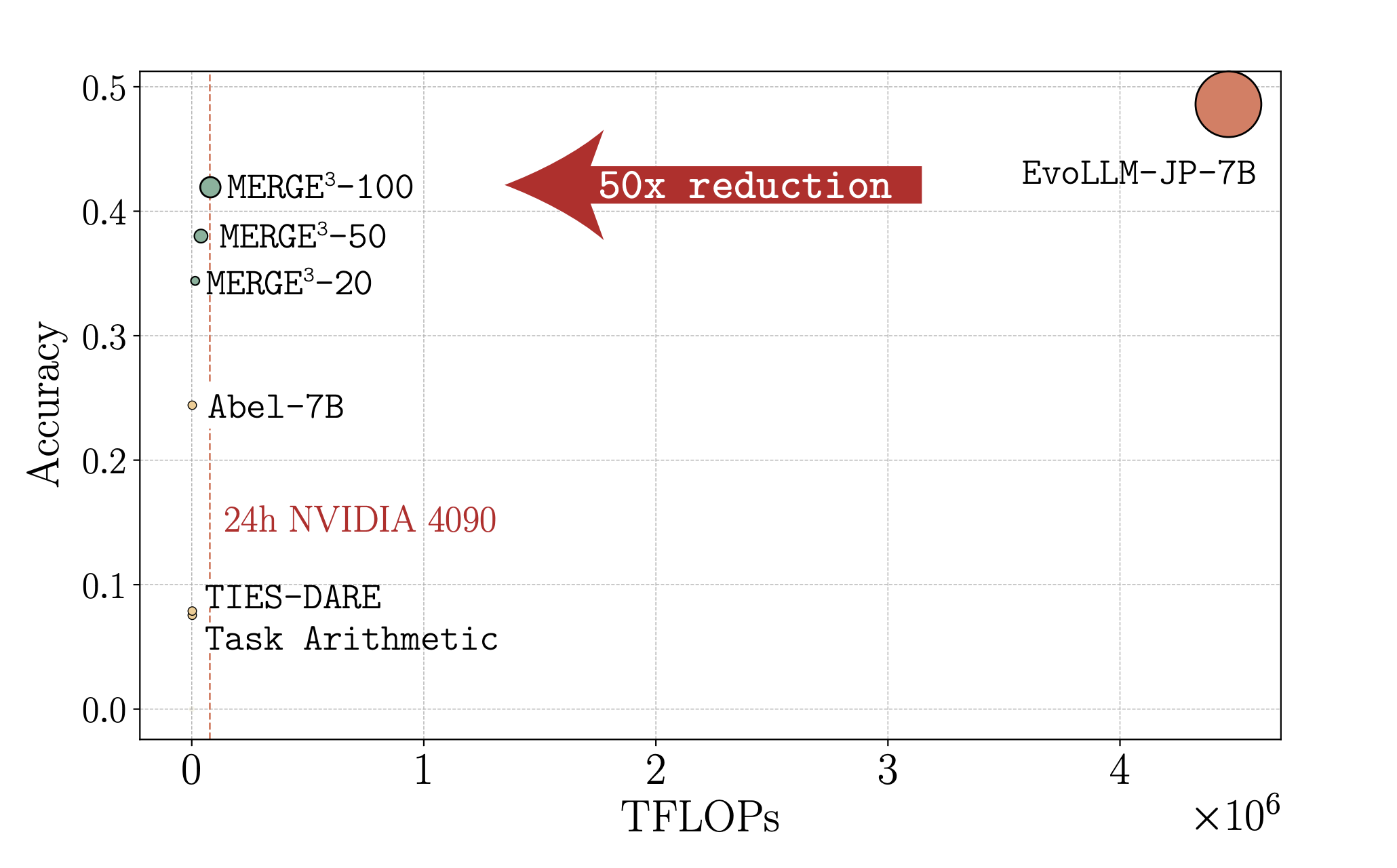
Evolutionary model merging enables the creation of high-performing multi-task models but remains computationally prohibitive for consumer hardware. We introduce MERGE^3, an efficient framework that makes evolutionary merging feasible on a single GPU by reducing fitness computation costs 50\times while preserving performance. MERGE^3 achieves this by Extracting a reduced dataset for evaluation, Estimating model abilities using Item Response Theory (IRT), and Evolving optimal merges via IRT-based performance estimators. Our method enables state-of-the-art multilingual and cross-lingual merging, transferring knowledge across languages with significantly lower computational overhead. We provide theoretical guarantees and an open-source library, democratizing high-quality model merging.